 Follow along
Overview
Sunday in the Park with George is an iconic Sondheim musical from the 1980s. It has a unique setting and soundtrack and is well worth the listen!
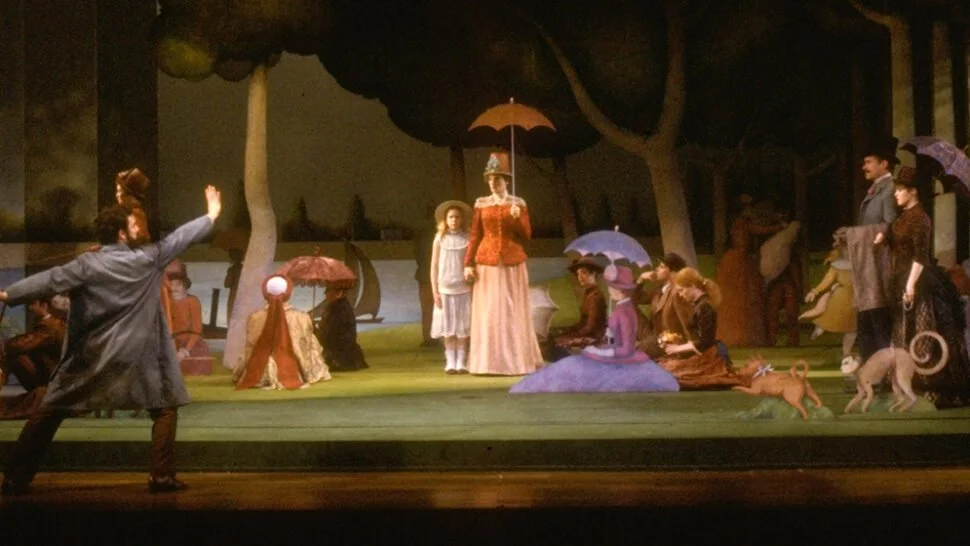
"Sunday", Sunday in the Park with George
History
When and where the show premiered:
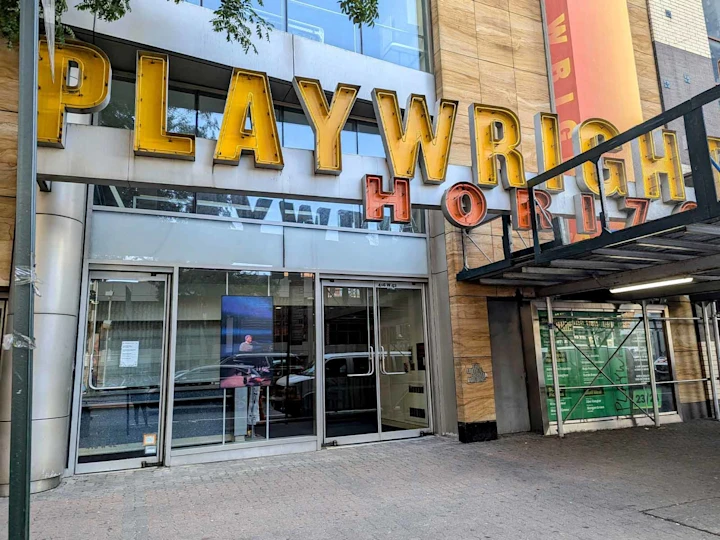
Jul. 6 1983, Playwrights Horizons NYC
Awards and Theatrical Run
- Won the 1985 Pulitzer Prize for Drama
- Was nominated for a number of Tony Awards, including Best Book of a Musical, Best Direction of a Musical, and Best Musical.
- Won two Tony Awards for design
- Won numerous Drama Desk Awards
- Won the 1991 Olivier Award for Best Musical
- Won the 2007 Olivier Award for Outstanding Musical Production.
After its Off-Broadway run, Sunday in the Park with George came to Broadway in 1984. It had a London run in 1990, as well as Off-West End in ‘05, and West End in ‘06. So far, since its premiere, it has had 2 Broadway revivals and the 2027 London revival is imminent.
Image: Playwrights Horizons, NYC
The Writers
Sunday in the Park with George was written by Stephen Sondheim (lyrics and music) and James Lapine (book).
About Stephen Sondheim:
- When they were children, he became close friends with James Hammerstein, and through this friendship became the protege of Oscar Hammerstein II - of Rodgers and Hammerstein.
- When he was around 23, before he fully “broke into” Broadway, he actually wrote scripts for a tv show called Topper, a supernatural sitcom that premiered in 1953.
- He wrote 18 full musicals in his lifetime.
- He won a Pulitzer, an Oscar, a Presidential Medal of Freedom, a Laurence Olivier Award, eight Grammys, and eight Tonys.
- He is considered one of the most influential & important American composers.
About James Lapine:
- He initially studied photography and graphic design at the California Institute of the Arts.
- He was 19 years younger than Sondheim - they met in 1982, and started work on Sunday in the Park with George around this time: Sondheim was 52, Lapine was 33.
- Directed the original “March of the Falsettos” in 1981, and in 1992 went on to write the book and direct the combined version Falsettos the Musical.
- Received the 2015 Mr. Abbott Award "in recognition of a lifetime of exceptional achievement in the theatre."
- He has directed much more than he has written - but has also won multiple Tonys for both his writing and directions.
Other Works
Stephen Sondheim has some well-known shows, but what about James Lapine? Let's take a quick detour to learn about what other things these fellas have written.
Some popular Sondheim works:
- Musical - A Funny Thing Happened on the Way to the Forum, 1962 [music & lyrics]
- Musical - Company, 1970 [music & lyrics]
- Musical - Sweeney Todd: The Demon Barber of Fleet Street, 1979 [music & lyrics]
- Musical - Merrily We Roll Along, 1981 [music & lyrics]
- Musical - Into the Woods, 1987 [music & lyrics]
- Musical - Passion, 1994 [music & lyrics]
Some popular Lapine works:
- Play - Twelve Dreams, 1978 [book]
- Musical - Into the Woods, 1987 [book]
- Musical - Falsettos, 1992 [book]
- Musical - Passion, 1994 [book]
- Play - The Moment When, 2000 [book]
- Play - Act One, 2014 [book]
Plot and Music
Plot
Act 1
Act 1 revolves around George (based on George Seurat) and his pursuit of painting his masterpiece. It follows George day by day as he sketches people he sees in the park. He begins with a blank white canvas, studying it and remarking on the challenge of bringing a picture to life.
- He starts by drawing Dot, his model and lover.
- More and more people gather in the park as he adds and subtracts elements from the scene.
- Throughout Act 1 he focuses on his masterpiece and we watch Dot’s growing frustration with his obliviousness as he is consumed by his work.
- We also discover that Dot is pregnant with his child, and is going to marry Louis the baker and move to America.
- The act closes with us in the park again with all of the prior characters engaged in various rendezvous, though Dot now carries her new baby.
Act 2
Act 2 skips ahead 100 years to follow the struggles of George's great grandson, also named George, who is “a conflicted and cynical contemporary artist.”
- We open where we left, with the people in the painting, and we see their reactions to George’s death.
- We then move on to 1984 and see George’s great-grandson as a frustrated artist in a museum where the painting is being displayed. We don’t fully find out his relation to George until Marie, his grandmother, reveals that she believes George Seurat is her real father (since she was raised with Louis as her father).
- Prior to this, we see his newest project, Chromolume #7, which is an invention-slash-sculpture that uses electricity and light to create images, and it explodes.
- We see George attempting to mingle with all of the people at the reception to honor George, and he leaves cardboard cutouts in his wake so he can be free of the chaos. There is discussion about what the painting contains, and some connections made between Marie (the grandmother) and George.
- We see the setting where the painting was originally dreamed up, very different now, and find out that Marie has passed. George now has in his possession Marie’s little notebook that was passed down from Dot, and begins to read it.
- As we begin to close out the show, Dot appears and speaks to George through the book, completing everything they couldn’t in Act 1. We make a full circle by the end, back to a blank white canvas.
- Roughly 2 and a half hours
- 18 songs, at least in the OBC recording
Main characters
George Seurat/George and Dot/Marie are the leads - the actor who plays George Seurat in Act 1/1884 becomes George, his great-grandson, in 1984, while the actress who plays Seurat’s mistress and model in Act 1/1884 plays his elderly granddaughter in Act 2/1984
Settings
Set in two settings, Paris, 1884, and an art museum, 1984. This show is slightly unique in its setting, Act 1 revolves around the painter George Seurat’s life in 1884 then in Act 2 jumps forward to 100 years later to focus on his great-grandson in 1984.
Length
Fun Facts
Inspired by
Sunday in the Park with George was inspired by the French pointillist painter Georges Seurat's painting A Sunday Afternoon on the Island of La Grande Jatte (painted 1884-1886). The character of George is named directly after the painter.
The Painting

More Fun Facts
- James Lapine tried to simulate the speech patterns of the late 1800s in France - by avoiding contractions and Latin root words.
- One of the songs in the musical, Chromolume #7, draws its name from chromoluminarism, which is the term that Georges Seurat used to describe his painting style (rather than pointillism, which was originally coined as an insult to painters who used this style).